
What Time It Is
Jesus Lives with Death Behind Him

Isaiah 2:1-5; Romans 13:8-14
For many of us, Advent signals a countdown to Christmas. You may have already put out your Nativity sets. Rowan Williams makes the point that thoughts of the Christ Child should not so easily fit into “no crying he made.” Instead, he notes that a baby lets us know what time it is and, as such, more often than not disrupts Time as we know it. And surely Jesus does this still.
Pastoral Prayer: Lord Jesus, we tend to measure our success by how well we manage our time. Others of us often feel as though Time is a creature we cannot tame. Why try to manage it? And yet, as we enter the Season of Advent, the Apostle Paul reminds us that we know good and well what time it is. By Your Spirit, make us to live in Your Time made new until the day You rectify all things, even that creature we call Time. May the words of my mouth and the meditation of all our hearts be Your Word for us this day. And all God’s people say, Amen.
The opening line of the American rock band Styx’s 1979 song, Borrowed Time begins,
Don’t look now, but here comes the eighties.
That seems so long ago. But it is as if time stands still. They crooned on,
I’m so confused by the things I read, I need the truth
But the truth is, I don’t know who to believe
The left says yes, and the right says no
I’m in between and the more I learn
Well, the less that I know
Across the pond, the same year, the British Band Supertramp released their album Breakfast in America. The hit song, The Logical Song seemed to convey the same thing,
When I was young, it seemed that life was so wonderful
A miracle, oh, it was beautiful, magical
And all the birds in the trees, well they’d be singing so happily
Oh, joyfully, oh, playfully watching me
But then they sent me away to teach me how to be sensible
Logical, oh, responsible, practical
And then they showed me a world where I could be so dependable
Oh, clinical, oh, intellectual, cynical
On his last album in 1984, with Yoko Ono, John Lennon lyricized about borrowed time.
Full of ideals and broken dreams, my friend
When I was younger, uh huh
Everything simple, but not so clear
Living on borrowed time
Without a thought for tomorrow
Living on borrowed time
Without a thought for tomorrow.
Borrowed time conveys the idea that the end has been postponed. The conditions that indicate something has come to an end, only to realize the world did not end.
The Apostle Paul wrote,
Besides this, you know what time it is.
Here we are in 2025. Soon, in what will feel like a minute, the calendar will turn to 2026. Most of us wear a wristwatch or keep our cell phones close so we do not have to ask, “What time is it?” But Paul wrote long before we could look at our wrists to know.
We begin the Season of Advent, or as my friend Ken Tanner reminds, Christian New Year’s. Christians began observing the Season of Advent in the 4th century. Several years ago, we used the theme from Fleming Rutledge’s Advent series, Advent Begins in the Dark. Her emphasis upon the conditions of the world always seems to be in the dark. That is, whether we are describing the world as it was in 1980 seems easily comparable to the years before Jesus was born. And though it does not cover the same time span, it is as simple to point out that the world seems as dark today as it did in 1980 or any prior era.
Hearing the prophets describe God’s Promised One in the Scriptures is not as hard to approximate as we think. That is, if the world is often sitting in darkness, we all would be game for someone to turn on the lights.
Surely Advent begins in the dark.
What is challenging is trying to fit our minds and experiences into a time before the Incarnation. After all, try as we might to appreciate what it was like then, we are on this side of the birth of the Messiah. The result has been to approach Advent as a time to prepare for the Second Coming, or second appearing of Jesus. Those in our branch of the Christian Tree, who are admitted latecomers to Advent, find this an easier headspace to inhabit. We long for the fulfillment of the Kingdom of God when all will be rectified in Time as we know it.
My friend Jason recently pointed to a sermon by Bernard of Clairvaux, who, about a millennium ago, put forward the idea that there is a middle place, a middle Advent if you will. Bernard describes it this way,
In case someone should think that what we say about this middle coming is sheer invention, listen to what our Lord himself says: If anyone loves me, he will keep my word, and my Father will love him, and we will come to him [Jn. 14:23].
There is another passage of Scripture which reads: He who fears God will do good, but something further has been said about the one who loves, that is, that he will keep God’s word. Where is God’s word to be kept? Obviously in the heart, as the prophet says: I have hidden your words in my heart, so that I may not sin against you.
Keep God’s word in this way. Let it enter into your very being, let it take possession of your desires and your whole way of life. Feed on goodness, and your soul will delight in its richness. Remember to eat your bread, or your heart will wither away. Fill your soul with richness and strength.
The Apostle Paul, in the last verse of our reading, puts it this way,
Instead, put on the Lord Jesus Christ, and make no provision for the flesh, to gratify its desires.
Bernard again,
. . . let it take possession of your desires and your whole way of life.
Fill your soul with richness and strength.
But the invitation is not to fill our souls with richness and strength from the ideals of Advent - hope, peace, joy, and love. The aim is not to seek the highest expression of these ideals within the narrative details preceding the birth of the babe in the manger. We look not to well-intentioned ancient teachings. Instead, the invitation is to receive the One who is hope, peace, joy, and love. Advent cannot be observed apart from Jesus, the Christ. And, these themes have no power apart from the Risen Christ. Therefore, we take as our theme for this Advent Season,
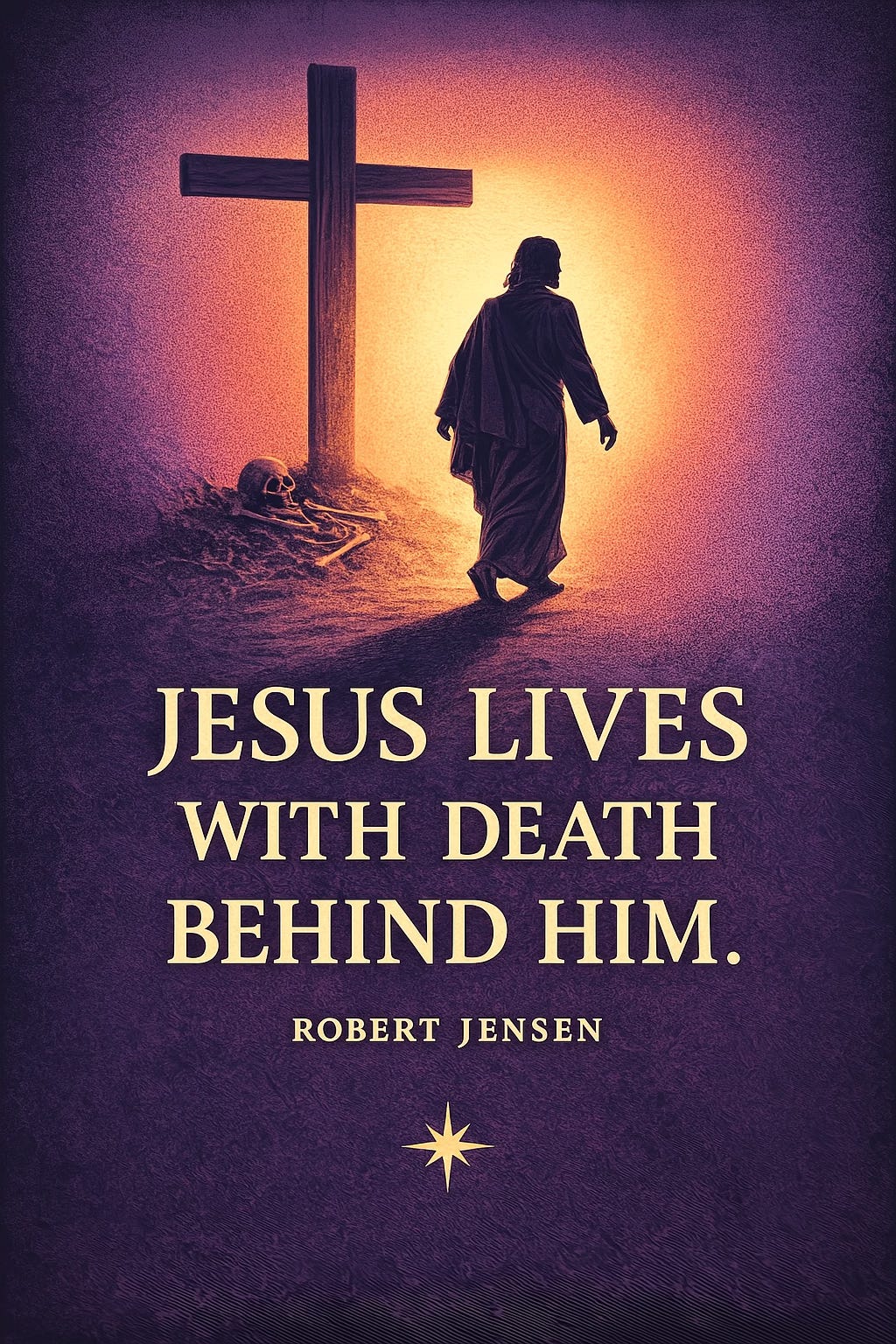
Jesus lives with death behind him.
That is to say that the Risen One has defeated the Powers of Sin and Death and has brought the Promise of the final rectification of all things into the present, with which he fills our souls with richness and strength.
The prophet Isaiah describes when,
In days to come
the mountain of the Lord’s house
shall be established as the highest of the mountains,
and shall be raised above the hills;
all the nations shall stream to it.
Fill your soul with richness and strength.
We hear, and with the mind’s eye we see the vision of the world made new,
They shall beat their swords into plowshares,
and their spears into pruning hooks;
nation shall not lift up sword against nation.
neither shall they learn war anymore.
And we wonder how this is so. After all, does the prophet know what time it is?
Paul, the Apostle, ties our awareness of what time it is with the claim that we are to,
Owe no one anything except to love one another.
The call to give love to and for one another is rooted in the very nature of God - a self-giving, other-directed love.
The love between the Father and the Son, the First and Second persons of the Trinity, is not an abstraction. Instead, it is consistent with the Father’s relationship revealed through the Son in the Gospel of John. There, we find that the relationship between Father and Son is one of mutual love and faithfulness. Love within God, that God has for Godself, is a love to be shared.
Therefore, the Father loves the Son and the Son loves the Father. Given that the Son describes the giving of the Spirit, the Holy Spirit, the Father loves the Son, the Father loves the Spirit, the Son loves the Father and the Spirit, and the Spirit loves the Father and the Son.
While it may sound as if we are talking in circles, we are describing what the Eastern Branch of the Christian Tree has described as a Divine Community of Love - Father, Son, and Spirit. Not a hierarchy but a We bursting with love to share. Creation is the overflow of that Love with the Divine Determination to share that Love with all Creation. Or, as we have noted before, the Triune God determined not to be God without us.
The vision of the prophet in Isaiah 2 may be expressed as the day we are filled with the richness of the love of God revealed in Jesus, the Risen One, and given strength to love what we once found out of reach. That is, to love not just those like us, but those who we have deemed as different.
There is a play of words. Paul notes that we owe love to one another. Another here is used to describe another of the same kind. Like loves like. Then, Paul tells us that those who love one another fulfill the law. In this line, a different word is used to describe another. It means another of a different kind. Like loves different.
Besides this, we know what time it is.
We often put off our own transformation to the future. Then we will be changed, we exclaim, “then we will love different,” when Jesus returns. The Apostle moves to describe what it means that Jesus lives with death behind him. When he comes to us in this middle Advent, we discover that the future reality has been brought into the present. When Jesus comes to us as the One who told us,
I will never leave you nor forsake you.
We cannot escape the present reality that Jesus loves those who are different, and does so with and through us, still.
We just spent five months looking at many of Jesus’ parables. He spent time with out-of-towners, down-and-outers, the possessed and oppressed, those not seeing and those thinking they were seeing, those with no hearing and those who thought they could hear, those who could not walk and those who believed themselves walking oh so holy. He spent time with the dead and the living, those with scandalous reputations and those who thought themselves squeaky clean.
For too long, Christians have split hairs over whom they are given to love, never stopping to think how hard they, we, themselves, ourselves, are to love. Loving others is not determined by which side of the church doors one is on.
For the one who loves another has fulfilled the law.
That is, the law is inscribed with what is best for others with whom we share the planet.
Too often, we have been taught to be,
. . . sensible
Logical, oh, responsible, practical
so dependable
Oh, clinical, oh, intellectual, cynical.
Discipled by the world instead of living in and with the presence of Jesus, we betray that we know what time it is. We are not living on borrowed time, but in Time made new by the Risen One.
Therefore, the Apostle tells us.
Besides, you know what time it is.
Here we are in the middle - Middle Advent. And when you see the works of Jesus around you, within you, you know it is time to stay awake, to put on the armor of light, Jesus the Risen One, to live honorably, and be filled with richness and strength by the One who makes this day closer than the day you first believed, that salvation is nearer both you and those Jesus loves through us, hidden as he is, made real through His people.
Jesus lives with death behind him - a victory and a reality won for us all.