
They Aren't Dirty
God's Way Is Jesus

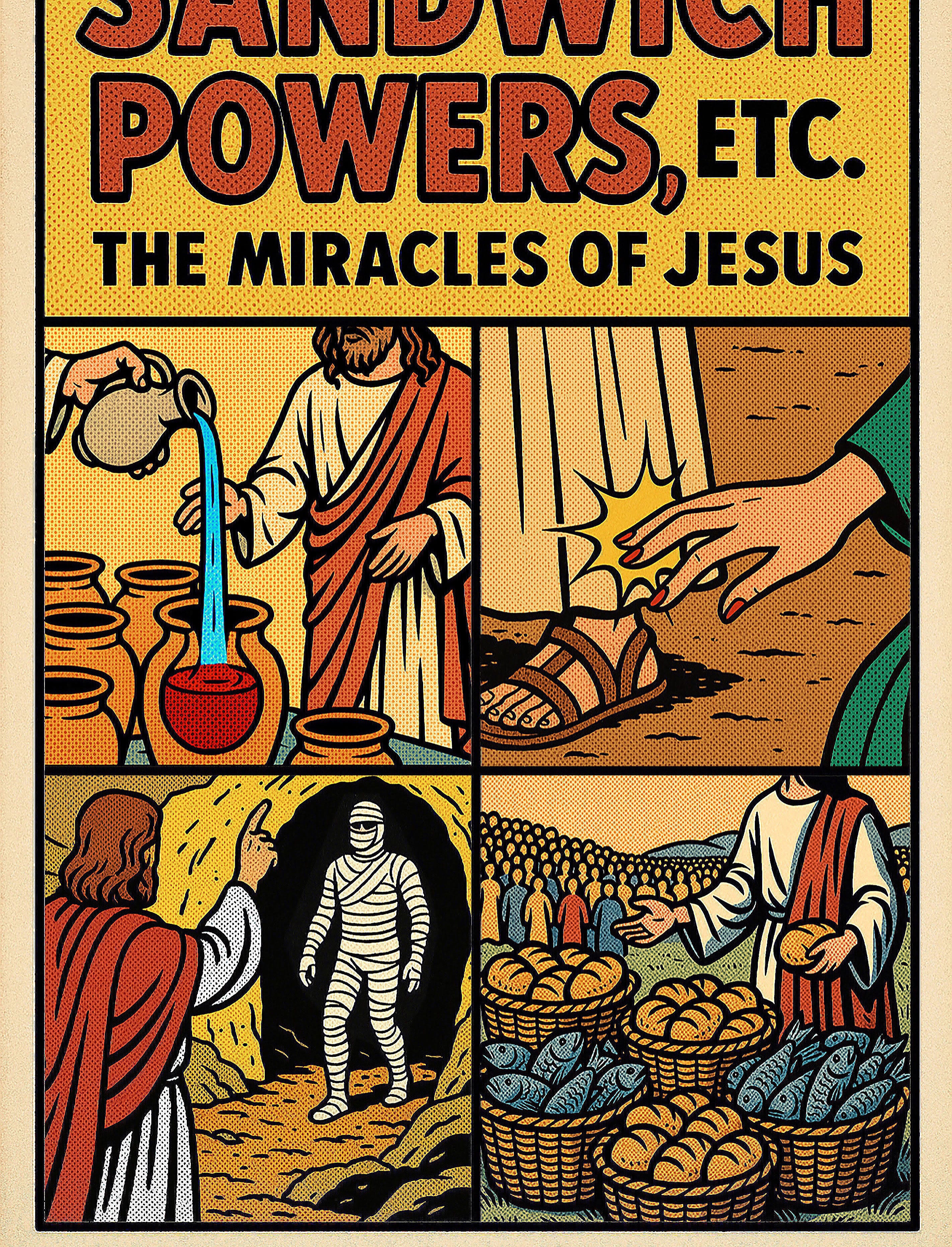
Matthew 15:21-28
Pastoral Prayer: Almighty God, it took food for Peter to realize what you have created we do not get to call unclean. That goes not just for animals. They are not dirty. Give us the Good News that Your ways are Jesus and not some undetected activity. May what is heard today be Truth and only Truth. And all God’s people say, Amen.
Imagine a couple of young Southern Baptist boys perched in front of a television set on Saturdays, watching American Bandstand. That’s right, sons of a Deacon, watching a show featuring dancing to rock and pop music—baptists y’all.
Some may wonder what American Bandstand is, or was. Think of it as the precursor to MTV. The show also gave rise to Soul Train. If you are not gobsmacked by now, then you did not get the traditions created by our Baptist elders - We don’t dance and don’t go with girls that do.
Despite the success of Kevin Bacon’s Footloose, with his appeal to the City Council for the privilege to host a high school dance in town by quoting the Bible, “and David danced before the Lord,” we who grew up in that era know it is not dancing so long as you have one foot on the ground. In other words, being taught to read the Bible literally was applied only when convenient.
And David danced before the Lord. He was singing and dancing.
We have a confession. On our fifteenth anniversary at Snow Hill, you honored us with an Alaskan Cruise. We looked over the available learning opportunities while sailing. We took in an educational film about Orcas. And we took a Salsa class—that is, a dance class. I looked like a clown. I blamed it on the waves we hit on the open sea. But growing up with the Baptist rules, I had rhythm in my mind but not in my feet.
Unbeknownst to you, when we had our thirtieth wedding anniversary, I scheduled salsa lessons. We have video proof that I, in fact, have been haunted by these rules and, true to form, cannot dance.
I really want to learn. But those rules have so blunted my ability that the freedom to dance is a future hope I have in the fulfillment of the Kingdom of God, when I might be able to dance before the Lord without worrying if my pastor might sneer at me.
Why do your disciples break the tradition of the elders? For they do not wash their hands before they eat.
Ever insistent on policing others’ holiness, the Pharisees police Jesus’s disciples. If Jesus cannot instill good hygiene practices in his followers by applying their traditions, how can he be trusted? The problem: the rule used is one they created. It is not a commandment.
Rather than answering the question, Jesus counters with how the Pharisees sidestep the commandment to honor their parents. They had created another tradition to avoid the commandment. Rather than honor them in their old age or when their resources were lacking, the Pharisees made a workaround. Instead of using their resources to care for their parents who cannot, they declare their goods and money Corban - dedicated to God. Thereby using their piety in shirking their responsibilities.
Intending to embarrass Jesus, Jesus flips the script and calls the crowd together and tells them,
It is not what goes into the mouth that defiles a person, but it is what comes out of the mouth that defiles.
The Pharisees took offense. This worried the disciples. Peter’s response makes it clear that the disciples did not have ears to hear. Dirty hands do not defile a person. What comes out of the heart through the mouth does.
What is Jesus to do with his disciples? Those who should understand him but don’t.
Leonard Sweet, the E. Stanley Jones Professor Emeritus of Evangelism at Drew Theological School, wrote Learn to Dance the Soul Salsa twenty-five years ago. In the chapter titled, Do Dirt and Do the Dishes, he described his mother’s habit of teaching him with stories.
As soon as I could stand on a chair, my mother conscripted me for sink duty. This involved more than clearing the table and scraping, washing, drying and putting away the dishes. It involved Mother’s handling each dish, placing it carefully in my little hand, and telling me its story - who owned it, how it got chipped, how she inherited it, why Dad bought it. Mother didn’t wash dishes; she valued them. Mother didn’t dust the furniture, she narrated it. Mother didn’t sweep the porch; she surveyed it.
Len could have been describing every Gospel writer. Taking the stories of Jesus like they were dishes in Len’s Mom’s sink, Matthew narrates the life of Jesus by giving us the events that reveal who He is. The miracle stories we have surveyed for the past five months support the Promised future we have bound up in the Promise that is Jesus, Mary’s Son and Pilate’s victim, Israel’s Messiah, and the Church’s Lord. These stories are for you! They are for us! The Preacher in Hebrews asserts that the Word is living and active - that is, it is always present to the day it is read or heard.
When we hear the stories of healing and restoration, we are witnessing what is natural in the Kingdom, not what is unnatural. We have lived too long in the world as it is, not as it will be. This world is not all there is. And this morning, we hear another event in which Jesus surprises the disciples and us. Rather than standing on a chair at Jesus’s sink, Jesus takes the disciples on a road trip.
Genassaret is seven hours in the rearview mirror by car. Gone from view are the Pharisees policing their every move. Away from the familiar confines of Galilee, Jesus takes the disciples on a field trip to what would typically be forbidden territory. The disciples worried about the Pharisees’ reaction to their unclean hands. You may be sure it would be harder for them to digest that Jesus has led them to a region full of what would be considered unclean people at best and enemies at worst.
Tyre and Sidon. Modern ports of Syria and Lebanon.
As soon as they arrive Matthew reveals:
Look! A woman comes out to Jesus!
Mark notes that she is a Syrophoenician woman. Matthew presents her as a Canaanite woman. This is not a matter of who is right and wrong. They are both correct. Mark would be making a contemporary reference that his first-century readers would have recognized. Matthew uses a historical reference —one that would have stirred memories of Israel’s past. Doing so emphasizes that the woman, a Canaanite, would have been associated with the pagan people Israel encountered upon entering the land of Canaan.
In fact, we cannot miss standing at the sink, learning the stories of the people. Those early listeners to Matthew’s Gospel may have recalled the difficult years under King Ahab, who had taken a Canaanite wife, Jezebel. She is credited with bringing the worship of Ba’al to Israel.
We might recall the women included in Matthew’s genealogy of Jesus. Tamar. Rahab. Ruth. Bathsheba. Without these foreign women, there would be no Son of David. It is not only that Matthew includes women, but that he includes these women who are Gentiles. That is, from the outset, if we are reading Matthew rightly, Jews and Gentiles are in the family tree of Israel’s Messiah.
If Jesus was looking for peace and quiet—a respite from the recent conflict with the Pharisees and from the long trip—the woman disrupted that plan immediately. However, if Matthew is tying the event with the one just prior, we may hear the events better if we keep the conflict with the Pharisees that prompted Jesus’s words to the crowd close by.
It is not what goes into the mouth that defiles a person, but it is what comes out of the mouth that defiles.
She came out shouting. And her words represent the first woman to speak in the Gospel of Matthew.
The woman speaks three times in her interaction with Jesus and the disciples.
Look! A woman comes out to Jesus!
And when she comes out, she directs all eyes to Jesus.
She comes out shouting,
Have mercy on me, Lord, Son of David.
Shouting.
Her plea for mercy is one among the many like Bartimaeus, the Ten Lepers, and the Blind men who, when Jesus came near, shouted, Have mercy!
The Canaanite Woman’s confession is among the highest in the Gospels. She recognizes Jesus. He is Lord of All and Israel’s Messiah. How is it she comes shouting her confession in the form of a request for mercy while living in what was likely a rural region in a foreign land?
We do not get those details. We must conclude that the Spirit of God had already revealed Jesus to her. Maybe it was one of those healed with loose lips who could not contain the healing and restoration they had received from Jesus themselves. It could have been the gossip spread by onlookers, those on the fringe who took the long trip to Galilee to verify for themselves that there was One whose feet were bringing Good News. My friend Jason, in his sermon on this passage, reminds that we often hear things like this and invoke the line,
God’s ways are not our ways.
That is, God does things differently. But what is better to understand is that God’s ways are not our ways because God’s ways are Jesus. Jesus is God’s different way! However, the woman heard of Jesus, she trusted what she heard, and what she heard was God’s different way.
Jesus will not leave her without mercy, for he is Lord of All and Israel’s Messiah. She trusted the Promise and Promised One. News of Jesus stirred the woman’s faith, enabling her to persist.
The woman shouts her confession and request.
Jesus remains silent.
For the first time, when faced with an appeal for mercy, Jesus does not respond.
We do not know why.
Suggestions range widely. Is Jesus reconsidering his mission? He had already told the disciples back in Matthew 10 not to go to the Gentiles. And here he finds himself confronted with a woman shouting her confession and request,
my daughter is tormented by a demon.
But if the field trip is for the disciples’ benefit. Maybe Jesus’s silence is to see what they will do. Already, they have preached the Good News, healed, and delivered many themselves. Would they have mercy?
What comes out of the disciples?
Send her away, for she keeps shouting after us.
Such needy people. If only she knew how to care for herself. People like her suck the life out of the system. If she were one of us, maybe we would help her.
What comes out of the disciples?
Where is their confession? Jesus, you are Lord of All, Israel’s Messiah. Relieve her of her burden.
Send her away, for she keeps shouting after us.
Matthew does not tell us to whom Jesus directs his words,
I was sent only to the lost sheep of the house of Israel.
Is this Jesus wrestling with his calling? Or is Jesus repeating aloud the sentiment deep within the disciples? Of us?
This is for us!
Jesus is the Good News, but we too often hear ourselves filling the silence with send them away; they are not one of us, away with these unclean people.
God’s ways are not our ways, for God’s way is Jesus.
Lord help me.
A second word comes from the woman to Jesus.
Maybe the disciples grew up with the idea that God only helps those who help themselves. It could be that this was the tradition of their elders.
Jesus gives voice to these deep, hidden sentiments.
It is not fair to take the children’s food and throw it to the dogs.
Do we take what is clean, hard-earned, and give it to those not like us?
God’s ways are not our ways, for God’s way is Jesus.
To declare another less than a human being made in the image of God is to reveal what is unclean in us.
Yes, Lord, yet even the dogs eat the crumbs that fall from their master’s table.
For the third time, the woman speaks. Her faith in who Jesus is will not let go. She will not let go of Jesus. In her words, she lets Jesus, the disciples, and us know she is already in the master’s house. Even those of us under the table eat the crumbs that fall.
Jesus declares,
Woman, great is your faith! Let it be done for you as you wish.
And the daughter was healed instantly.
Jesus, the Bread of Life, was and is the food that fed the woman, whether by loaf or crumb. She was not unclean. She was not dirty. For God’s ways are not our ways - Jesus is God’s way and Jesus will not let her go - or you - or those we consider dogs under the table. So, you persist too.
Great sermon Todd, I really liked this one.