
Preaching Is Dead?
"The report of my death has been greatly exaggerated." Mark Twain

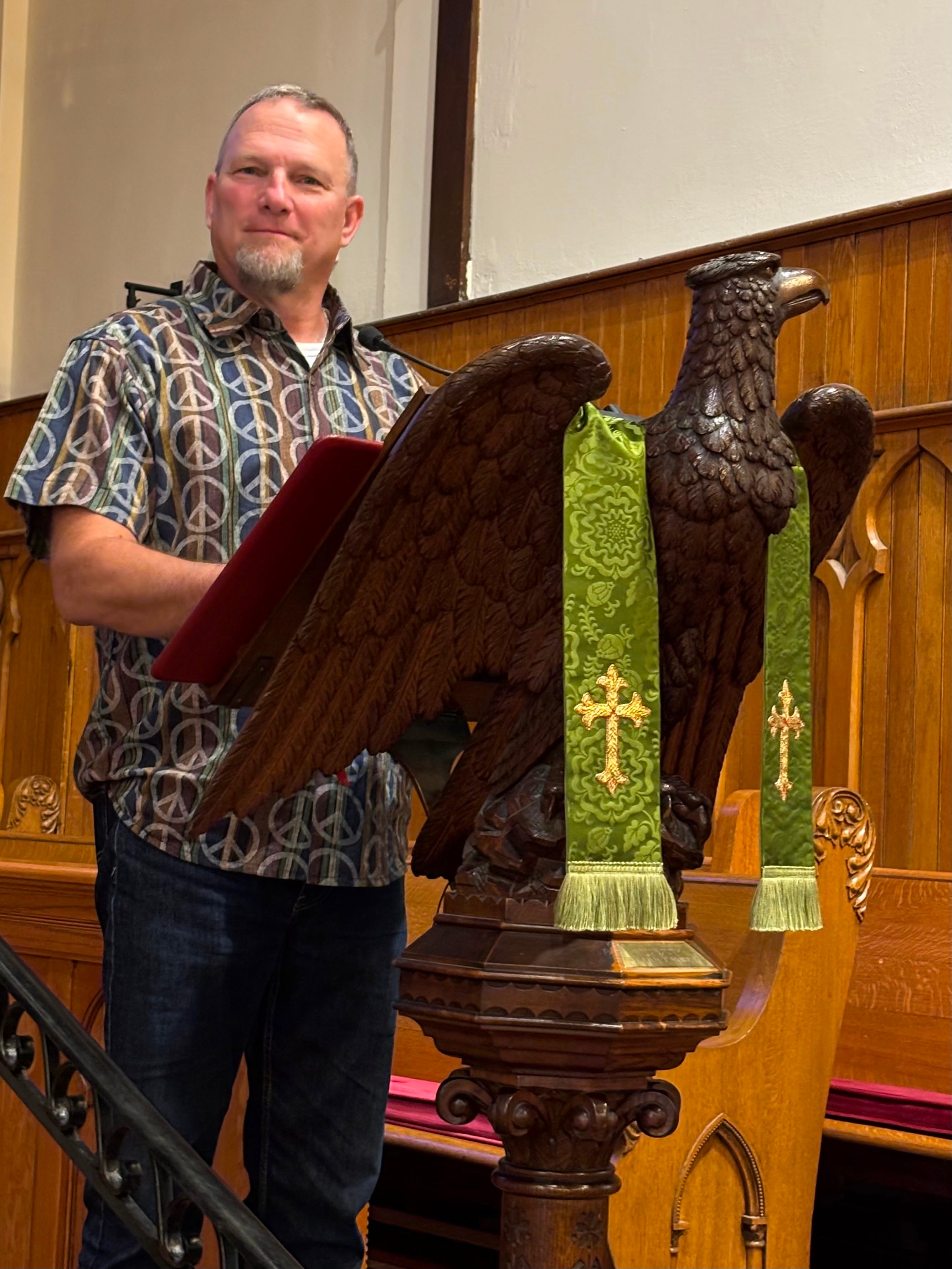
Furnishings in high church sanctuaries intrigue this low-church, free-church pastor. The Eagle Lectern in Christ Episcopal Church in Charlottesville, Virginia, is the latest to draw my attention. Many are unfamiliar with the Eagle Lectern and would mistake this for an American Eagle. However, the Eagle Lectern dates to at least the Thirteenth century and is often considered to represent John the Apostle. On this Eagle Lectern rests a very large open Bible. My friend Josh took the photo while we were taking in the stained glass and the well-preserved woodwork throughout the church.
About twenty years ago, a voice thundered from a different platform behind a different lectern.
Preaching is dead! The speaker proclaimed.
To be fair, the announcement fit the theme that American Christianity was entering a new era and, with it, the need to rethink everything from preaching to publishing, from discipleship to worship. The short-lived movement found interest in deconstruction. Not many years later, the late Phylis Tickle would refer to this moment as The Great Emergence. Tickle described deconstruction as the church having a garage sale, something that occurs every 500 years in the history of the church, as she sketched it.
I was at the Emerging Church Conference, led by young church leaders, taking stock at the turn of the millennium and considering how the church might respond. In an adjacent hall was the National Pastors Convention, which I had attended the year before. Considering myself young, I was interested in hearing how the church might face changes in an emerging culture. It is where I heard:
Preaching is dead! The speaker insisted.
For some, as the movement progressed, it was the furniture. Rows of pews facing forward toward a person felt more like a lecture hall. The solution was a more informal setting, in the round, on much more comfortable seating. Add that the person up front dressed like a lecturer, dressing down became its own symbol; this is not your parents’ church. Add the felt need to change the room's ambiance, and it was not surprising that some both supportive and critical referred to this as smells and bells.”
Others in the movement took the view that as times change, the message must change. Re-arranging or changing the furniture raised a few hackles. But the question of the relationship between changing times and the timeless message became another matter. For example, the book The Church in Emerging Culture: Five Perspectives attempted to provide a congenial way to broach a sensitive topic. Five respondents each offered an essay on their position: that the method and the message do not change to the other end of the spectrum, and that the emerging culture requires both changing methods and a changing message. This segment of the movement raised the issue of the intersection of theology and preaching. If a few hackles were raised when rearranging the furniture, questioning theology and preaching did.
“Preaching is dead” became both a hyperbole and a conviction that no one listens to sermons anymore, at least not like those your parents and grandparents sat through. But what would this mean? What does it mean? And, now twenty years later, we are still asking what of the intersection of theology and preaching? Are we past telling the old, old story? What are the new ways we might tell an old, old story? And if the message changes, what exactly is the story?
Preaching is dead?
Twice this year, I have spent a few days with some twenty pastors/preachers from ten different denominations. These ministers represent both high church and low church traditions. None of them thinks preaching is dead. Otherwise, they would not have filled out an application for the second cohort of the Iowa Preachers Project (IPP).
Many, if not all, of these pastors/preachers were taught the how-tos of sermon development. They did not sign up for a refresher in sermon preparation. Something within them recognized the need to continue honing their preaching skills to avoid the ditches preachers often fall into. Pastors are not stand-up advice columnists, political pundits, or self-help gurus. It is easy to be influenced by the success of talking heads, social media influencers, and the like. This is our current environment. These participants know there is Good News in the Risen Christ and that words matter when proclaiming the Living Word. The Word that delivers a Promise to a world holding onto the last knot in their rope.
During the final feedback session on the future of the IPP, an Eli Lilly Endowment grant-funded project under their Compelling Preaching Initiative, one young preacher identified a good way to describe the IPP.
There’s a school of thought emerging out of Iowa (insert field of dreams joke here). As in Antioch, Alexandria, and Vienna in prior generations, a conversation begun and ongoing for generations is beginning to coalesce around a series of questions: What is a sermon? What is a good sermon? What makes it good? What’s it for? And how is it different from all other forms of speech.
The deadline has passed for the next cohort that begins in September. However, an Advisory Board is working behind the scenes to ensure the sustainability of this project, this school of thought. I am glad to serve on that Advisory Board, to have met the Founder, Ken Sundet Jones, and to know that my friend Jason Micheli is the Preacher-in-Residence for the IPP.
The Eagle Lectern is often considered a symbol of the Gospel's delivery to the four corners of the earth, according to a Wiki article that references A Guide to Church Furniture. If the Eagle Lectern is a symbol, the church’s proclaimers become the in-the-flesh messengers on whose lips the Good News is declared. And while some preaching may need to die, the Story that gives us the Promise of God continues to be told, with the subject of the sermon being the crucified and risen Christ, who just is, the God named Father, Son, and Holy Spirit.
To adapt Mark Twain,
The report of the death of preaching has been greatly exaggerated.
Occasionally i have to preach in a traditional church but it does not feel natural. Since 2000AD I have been a digital storyteller, using multiple screens and projectors and VJ software for young people. I can do this at youth camps and festivals but not inside church buildings which are not designed for it.
Super photo Todd, looking good