
Into Your Hands
Gift and Giver

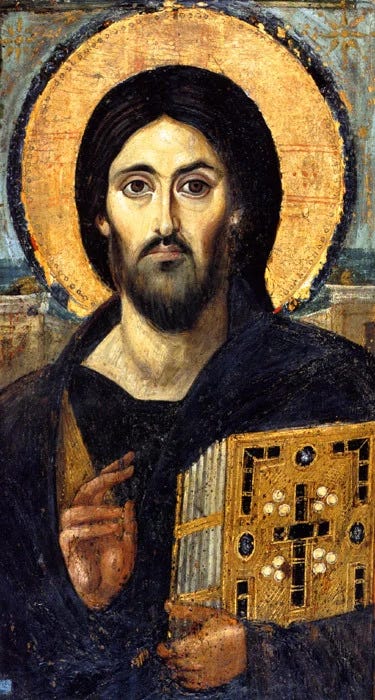
John 1:1-18
Pastoral Prayer: Gracious Father, out of the overflow of Your love, we receive grace upon grace. May what is heard be Your Word for us this day. And all God’s people say, Amen.
“Hold the light.”
“If you can’t see it, neither can I.”
Being born the oldest son of the youngest of eight children meant being the first to assist Dad with many a DIY project. One of my first recollections of fulfilling my official duty as “Light Holder” came from changing the brake pads on the 1965 Ford Country Esquire Station Wagon. My parents bought the car new. It came with an AM/FM radio, vinyl red interior, and the faux wood panel inserts running down the sides of that long car. When we needed it, the cargo space in the very back of the car could be opened to produce extra seating. Think of it as one of the first automobiles to seat nine.
It must have been after the end of Daylight Saving Time because it was dark after Dad got home from a long day working at O.G.&E. Dinner was over, and we went to work.
“Hold the light, son.”
I pointed the light toward the wheel well of the driver’s front tire. To this day, I do not recall exactly what part we were looking at, but the wheel well seemed lit up to me. Then Dad said,
“If you can’t see it, neither can I.”
We did replace the brake pads. That station wagon became my first driver. It was also my first business vehicle, serving our land mowing venture for several summers.
When it came to our cars, we replaced brake pads, water pumps, and thermostats, and performed oil changes, among other auto repairs. We built a 1946 Chevrolet pick-up I’d love to have back. On other occasions, we repaired plumbing and electrical wiring, repaired roofs, poured concrete, cleaned and laid brick. We even added on to the house we grew up in on 17th Street. I say we because Paul got in on the activities, too. The house is still standing.
The age difference between my Dad and his oldest sister was 18 years. So, by the time we came along, children of the youngest in the family, Grandpa Littleton could no longer perform repairs. You see, my grandparents once owned apartments in uptown Oklahoma City. There were times when we would accompany Dad to make repairs. To hold the flashlight.
While I did know Grandpa Littleton, who died in my sophomore year in high school, one of the ways we knew him better was to learn from Dad what Grandpa had taught him.
The Preacher in Hebrews opened his long sermon this way,
Long ago God spoke to our ancestors in many and various ways by the prophets, but in these last days he has spoken to us by a Son, whom he appointed heir of all things, through whom he also created the worlds. He is the reflection of God’s glory and the exact imprint of God’s very being, and he sustains all things by his powerful word.
Two hundred years before John wrote his Gospel of Jesus Christ, the Hebrew Old Testament had been translated into Greek, known as the Septuagint. John likely used the Septuagint, the Greek translation of the Old Testament, when he began,
In beginning was the Word, and the Word was with God, and the Word was God. He was in beginning with God. All things came into being through him, and without him not one thing came into being.
Speaking requires words. And when John set out to let us know what God was up to from beginning, he chose the word logos, “word.” Therefore, God has always been a God who speaks, One who communicates.
And, what John relays, along with the Preacher in Hebrews, is that when we want to know the One whom Jesus calls Father, we listen to the Son.
David Ford begins his commentary on The Gospel of John with this paragraph,
“From his fullness we have received, grace upon grace” (John 1:16). John is a Gospel of abundance. The prologue first sounds this note; the first sign that Jesus does is turn a huge amount of water into good wine; the Spirit is a wind that blows where it will and is given “without measure” (3:34); the “living water” that Jesus gives is “a spring of water gushing up to eternal life” (4:14); when Jesus feeds five thousand with five loaves, there are twelve baskets of fragments left over; through Jesus there is abundance of glory, healing, light, life, truth, faithfulness, joy, and love; the last sign that Jesus does brings about a large catch of big fish; and John’s closing sentence responds to the impossible task of writing all that could be said about what Jesus did: “If every one of them were written down, I suppose that the world itself could not contain the books that would be written” (21:25)
The idea that we could adequately work through the 18 verses that make up our reading for this morning would require an abundance of time.
So, with the table set before us to celebrate the Lord’s Supper, the Eucharist, the meal of thanksgiving for the Gift and the Giver, we will put our attention on the Word become flesh who makes the Father known, having always been at his side.
The Word was with God.
πρὸς τὸν θεόν
One way to hear that Greek phrase is that the Father and Son were face-to-face. Such a description conveys a sense of relationship and intimacy. If we take the description of the activity of the Spirit in Genesis 1,
And the Spirit of God hovered over the face of the deep.
We underscore the Church’s Trinitarian confession. The Triune God, Father-Son-Spirit, in an intimate relationship of love determined to love from beginning.
Jesus was with the Father from beginning.
Εν ἀρχῇ
This Greek phrase has no definite article. John is saying something important. There is no beginning for God. Notice, while the Story God makes for Godself in Scriptures has a beginning, God has no beginning. The Orthodox way of describing the relationship between Father-Son-Spirit is a “Divine Dance of Love.” And that in Christ Jesus we are invited into that dance. That may be unfamiliar to your ears and mine, but it reminds us no less than that God loves first and pursues us in love. Pressing the illustration further, in the Love That Is God, we learn a new dance. The Triune God knows we are out of step with Love and will not leave us to dance to the beat of our own drum - a beat out of sync with God’s love.
The Triune God is always.
Lest you think this is more for an academic setting, this is eminently practical for our understanding of God revealed in Jesus. That is, the Story God makes for Godself is not interrupted, requiring, as my friend Jason puts it, “In case of emergency, break glass and initiate plan B.”
In her book, The Crucifixion: Understanding the Death of Jesus Christ, Fleming Rutledge includes this quote from Calvin,
Then, rather charmingly, he writes, “But to render these things more certain among those who require the testimony of the ancient church, I shall quote a passage of Augustine where the very thing is taught.” Here is the quotation, from Augustine of Hippo (fifth century) via John Calvin (sixteenth century): God’s love is incomprehensible and unchangeable. For it was not after we were reconciled to him through the blood of his Son that he began to love us. Rather, he has loved us before the world was created. . . . The fact that we were reconciled through Christ’s death must not be understood as if his Son reconciled us to [the Father] so that he might now begin to love those whom he had hated. Rather, we have already been reconciled to him who loves us, with whom we were enemies on account of sin. The apostle will testify whether I am speaking the truth: “God shows his love for us in that while we were still sinners Christ died for us” [Rom. 5:8]
We know the Love That Is God through the Son. John writes,
No one has ever seen God. It is God the only Son, who is close to the Father’s heart, who has made him known.
Close to the Father’s heart.
Made him known.
Jesus reveals the heart of the Father. Jesus makes it known the Father’s heart toward his creation - toward us.
From beginning.
God’s love has always been self-giving, other-directed.
This avoids any notion that God is worried, even concerned, for us. Instead, what Jesus reveals is God’s love for us and a faithfulness lived out in the Son that becomes ours and thereby changes us.
When John continues his Gospel, as Ford points out, the abundance of God’s love shows up in sign after sign to the very end.
Not only is Jesus with the Father from beginning, but Jesus is also with us.
And into our hands, Jesus is given.
Notice these lines from John’s Prologue.
In him was life, and the life was the light of all people. The light shines in the darkness, and the darkness did not overcome it.
The true light, which enlightens everyone, was coming into the world.
He came to what was his own, and his own people did not accept him.
And the Word became flesh and lived among us, and we have seen his glory, the glory as of a father’s only son, full of grace and truth.
But to all who received him, who believed in his name, he gave power to become children of God.
The light shines in the darkness.
The true light was coming into the world.
To all who received him.
And lived among us.
We have seen his glory.
Jesus, the Word from beginning, The Human One pointed to in Daniel, the Word Become Flesh, Mary’s Boy and Pilate’s victim given into our hands. And our darkness does not overtake or comprehend. His light cannot be extinguished, for it has always been driven by the Love That Is God. Risen and Living, still.
And so Jesus gives us the Father. He reveals God to us. And that God is with us, still.
And into our hands, still.
Jesus shares a meal with the disciples. And as he does, he tells them,
This is my body.
This is my blood.
While it may be startling to you, especially we who tend to think of the Lord’s Supper as a memorial, when we take the bread into our hands, and the cup into our mouths, we are given Jesus - his words. Call it a mystery. But it is more than a symbol. It is at least a reminder that there is One, Jesus, who is closer than a brother. And this One who has been with the Father from beginning is with us always, even to the end of the age.
So we say again:
So, with the table set before us to celebrate the Lord’s Supper, the Eucharist, the meal of thanksgiving for the Gift and the Giver, we will put our attention on the Word become flesh who makes the Father known, having always been at his side.
And now into your hands.