
He Told Us So
Remember?

* From time to time, there are differences between the delivered sermon and the prepared sermon. This is one of those instances. He is risen!
Pastoral Prayer: Living LORD, few, if any, of us have NOT heard the refrain, “I told you so!” Maybe we recall being told not to touch the hot stove or plunge our fingers into a plug socket, only to hear, “I told you so,” after seeing for ourselves. Just last night, as the rain increased and high waters rose, one of our local weather people looked at the camera in disbelief, “Turn around, don’t drown,” after showing video of people driving their cars into high water. It does seem a bit more reasonable that the thought of a dead man alive again would be met with a side eye. “What you say?” But here we are, another Sunday, another Easter Sunday, and we are here because “He said so.” We are here to remember that despite our reservations about what we have not experienced, Jesus said, You said on the third day You would rise again - and You did. Give us the Good News again today. May what is heard today be truth and only truth. And all God’s people say, Amen.
We told them. We did.
“Could we meet in your office?” came the voice on the other end of the line.
It was nightfall. The day had already been long. Fortunately, Dad and Mom were with us. We left the girls with them at the parsonage next door. My new office, new to me, was bare. I had not had time to set it up. That would come on Monday. Tomorrow was Sunday.
“We feel like you took advantage of us.” We sat and listened as they unloaded their frustration.
Sharon had offered to take Kimberly and entertain her while we ran errands out of town. We did not know her well. Today, she would have had to have a complete background check!
Neither Patty nor I knew the lay of the land. We did not know how long it would take to drive to this stop or that, or what traffic might be like. All we knew was that we had some errands and felt, frankly, obligated to leave our six-year-old with a church member we had met only a couple of times at the woman’s insistence.
We took longer than she expected, longer than she wanted. As we sat in that cold, empty office, they berated us for taking too long. Sharon had left a note on the parsonage door. “Where are you?” with a time stamp. She drove by not once but almost a half dozen times. Each time, another time stamp was added. Yes, youngsters, this was before cell phones.
“I’m a 40-hour-a-week working woman," she intoned.
We apologized and explained that we did not know how long our errands would take. We would not let it happen again.
Patty fell into my arms as we walked down the pathway from the Office to the parsonage. “Why did we come here?” she cried. Did we make a mistake? We wondered. Our only way to overcome the moment was to remember, “He said so.” He being Jesus. There would be more than one moment when we asked that question.
We fell. We dropped.
We had nothing short of a decensus - our organs fell. Our hearts sank. Our legs faltered.
The narrative in the Gospels leaves little doubt that the disciples’ hearts sank watching Jesus being led away from Gethsemane. Their expectations were dashed, and their fears rose. Would they take us, too?
We low-church, free-church folks have busy schedules. Most of us did not grow up with more than Palm Sunday and Easter Sunday. Maundy what? Good Friday? Holy Saturday? Our friends from other traditions talked of going to church on those days. Who goes to church on Thursday and Friday? Sermon planning requires a decision. When do we include the Passion of the Christ or the time he died? Low in the Grave He Lay? Do we do too much on Palm Sunday? Or, do we risk sending worshippers to a late lunch on Easter Sunday?
We worshipped on Thursday, remembering Jesus’s last meal. We recalled Jesus’s words, “This is my body. This is my blood.” As we left, we gestured toward the betrayal and crucifixion, pointed to Holy Saturday, and said we would see one another today.
In her book The Crucifixion: Understanding the Death of Jesus Christ, Fleming Rutledge offers a chapter titled, The Godlessness of the Cross. Fleming would argue that the tree upon which Jesus was gruesomely killed cannot be captured in fine jewelry. Cross wearing is not the same as cross bearing. It was such a horror to portray. The mode of Jesus’s death was the point of his execution, she writes.
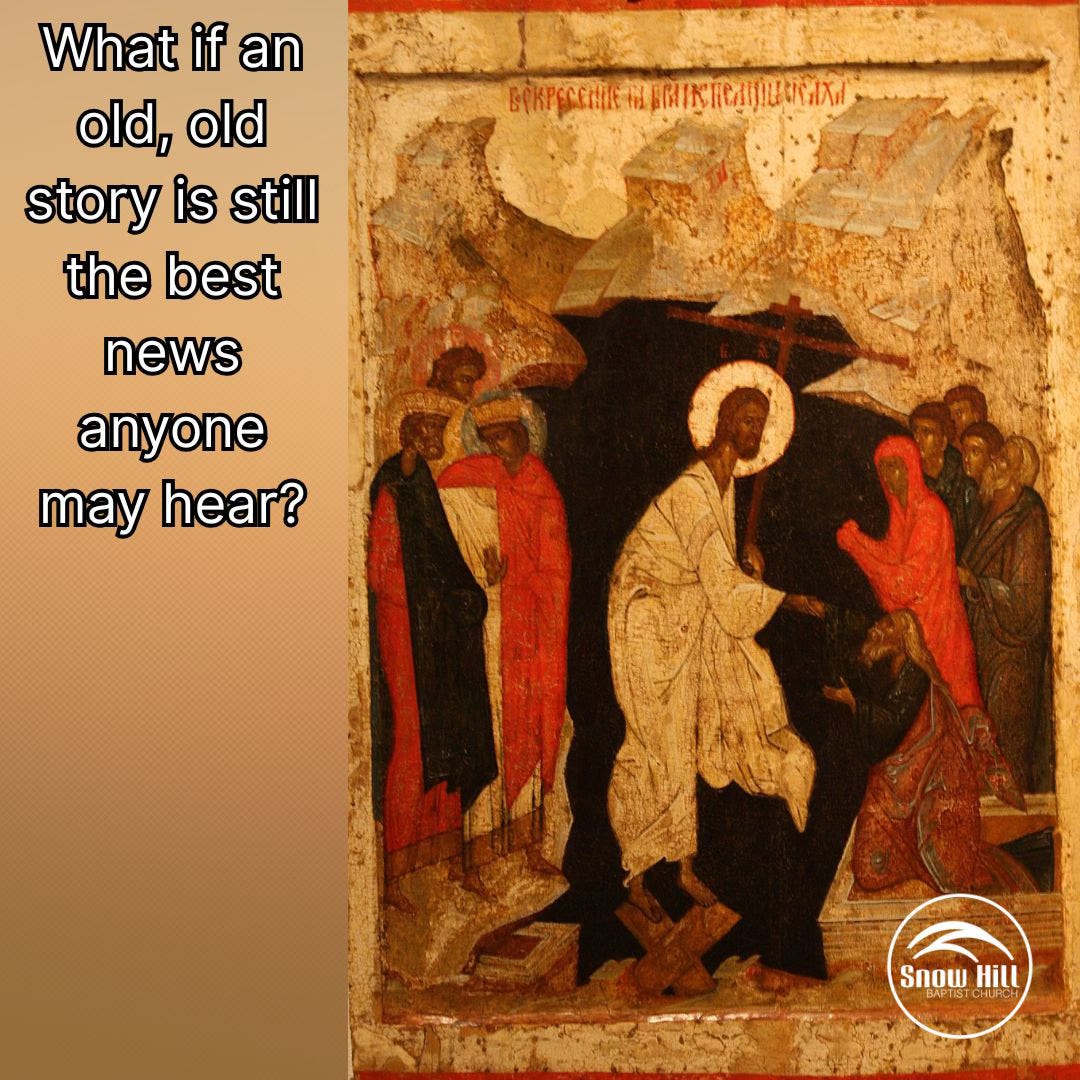
Rita Brock and Rebecca Ann Parker wrote of their search for early Christian art in their book Saving Paradise. To their surprise, the earliest art displaying Jesus was of the Resurrection, not the crucifixion. Not until between 800 and 1000 years after the Resurrection does any portrayal of the crucifixion appear.
Yet, He told us so.
Remember, the two men told the women at the tomb that he would be handed over to sinners and be crucified.
He told us so.
The Gospel accounts provide us with the narrative arc. Jesus came preaching the Good News of the Kingdom. Repent and believe the Good News, he proclaimed. Along the way, Mary’s son began forgiving sins. Maybe you recall Luke’s story. A paralyzed man had some friends who believed Jesus could help. The house where Jesus was to be found was packed. Finding no way in, they went upon the roof, cut a hole in the roof, and lowered their friend right in the middle of the crowded house.
Friend, your sins are forgiven.
The religious powerful went verklempt, shouted accusations of blasphemy, and demanded to know where Mary’s son gets off doing what only God can do. As if to say, I told you so, Jesus said,
But so that you know that the Son of Man has authority on earth to forgive sins - he said to the one who was paralyzed - I say to you, Stand up and take your bed and go to your home.
He said so.
The Good News - Jesus has the authority to forgive sin, for he has the power over Sin.
He said so.
We have been in Luke for some time. Our theme since January has been Lights and Action - a way to call attention to God revealed in Jesus. We arrive here some fifteen weeks later to conclude that Luke, the Gospel writer, conveys what Jesus said and did. Combining proclaiming and teaching with healing and liberation, Jesus has fulfilled the Promise God had been announcing all along. Nothing will get in the way of God keeping His Promise. So committed to His own Word, God took up the keeping of his Word and the fulfillment of that word Himself. Therefore, He has shown us in Jesus that He authority over all things that nothing will separate us from the love of God in Christ Jesus.
He said so.
So Jesus declares the authority to forgive sins and has authority over the Power of Sin. Jesus calls out the minions of evil that oppress and possess, thereby showing authority over the Evil One. Jesus turns leprous bodies clean, withered hands whole, faulty limbs to work again, and blind eyes to see, thereby showing authority over all that ails us. Jesus raises sons and daughters, thereby demonstrating the power over the Grave and therefore power over Death. And when Jesus is said to descend, we, with the early Christians, declare that Jesus has power over Hell.
Both Peter in his circular letter and Paul in his letter to the Ephesian Christians describe what the early church took to be the decensus, or the Descent of Jesus.
Today, decensus often refers to the falling of an organ, a human organ. They are no longer able to function or lift the body to health. It was applied to Jesus to say he was dead, dead. By death we say he defeated Death, the last enemy of God. And for those who had not heard the Good News, imprisoned in the underworld - the realm that fell under the biblical names Sheol, Hades, and Gehenna - Jesus proclaimed His victory. He led captivity captive.
Now, before you raise your objections, even your hackles, I do not understand it all. In black and white, in Peter and Paul, in Luke and more, Jesus demonstrates that there is no Power greater than that of the Triune God. I can only take it that anyone who remains in Hell’s prison has refused to leave, though the gate of the cell is open. Jesus is the Way out from under the Powers of Sin, Death, the Grave, Satan and Hell - all words used to describe the Enemy.
Paul helps us understand that Jesus's Resurrection is God’s vindication, the Father’s Way of saying, "We Said So." The undivided Triune God—Father, Son, and Spirit—vindicates all that Jesus, the Son of Man, Son of God revealed in the Resurrected Son.
He said so.
and on the third day rise again.
Christ is Risen.
He is Risen indeed.
Great sermon Todd. Glad I listened to this as well as read it.