
Get Out More
Made Well

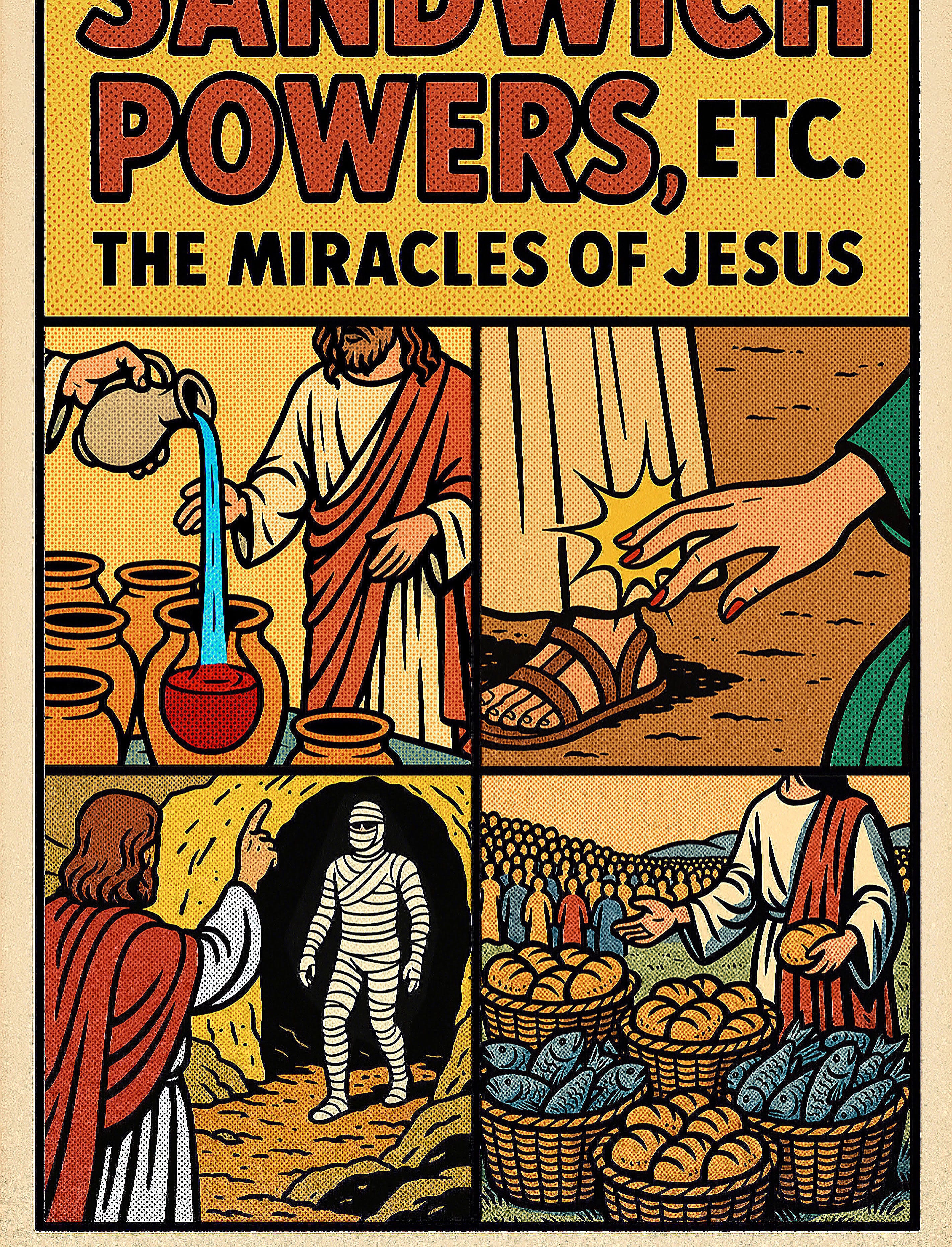
John 5:1-18
Pastoral Prayer: Almighty Father, we yearn for more power than we possess. And yet, we do not indicate that we would use that power for other than our own advantage or benefit. Remind us of the Good News that Jesus, Your Way, became powerless for us so that we might find victory over the Powers that hold us. We ask that by Your Spirit who makes alive in us the presence of the Son that you make us busy doing what the Father does. May the words of my mouth and the meditation of all our hearts be pleasing in Your sight, O Lord, our Rock and our Redeemer. And all God’s people say, Amen.
Have you fallen asleep praying? If so, you are in good company.
The late Pope Francis hosted 200,000 people in St. Peter’s Square in 2013. He took four questions. During his answers, he admitted that after a long day, he prays before bed.
“Sometimes I doze off, the fatigue of the day makes you fall asleep, but he (God) understands,” he said.
The humor did not overshadow a sober challenge.
“If we step outside of ourselves, we will find poverty, . . .,” he said from the steps of St. Peter’s Basilica
“Today, and it breaks my heart to say it, finding a homeless person who has died of cold, is not news. Today, the news is scandals, that is news, but the many children who don’t have food - that’s not news. This is grave. We can’t rest easy while things are this way.”
“We cannot become starched Christians, too polite, who speak of theology calmly over tea. We have to become courageous Christians and seek out those (who need help most),” he said.
When Jesus saw him lying there and knew that he had been there a long time, he said to him, “Do you want to be made well?”
Imagine the scene.
Jesus walks into Jerusalem. Maybe he enters the northeast of the city through the Sheep Gate, which is now called St. Stephen’s Gate. He looks out across an area larger than a football field at two large pools, named here as Beth-zatha or Bethesda. You may recognize the name as that of a noted hospital bearing the name Bethesda. Today, St. Anne’s Church is adjacent to the excavated area. There, Jesus sees a multitude, a plethos, a crowd.
Jesus has seen crowds before. Remember, he saw a crowd on a hillside where he had been teaching all day and instructed his disciples to feed them. He fed 5,000 men, not nearly all who were there that day, for women and children were in the crowd. Jesus has seen a crowd described as sheep without a shepherd. And crowds gathered during the days of his itinerant ministry around Galilee. Friends and relatives brought those who were sick and afflicted to him.
Here, on this day, Jesus sees a crowd with little hope. This is not an all-inclusive resort. It is not a creatively designed couple of pools, complete with chaise loungers on which to recline underneath oversized umbrellas to keep the sun out. There are no waitstaff offering to bring you something from the menu. You only visit these pools under the most dire circumstances.
This is a crowd John describes as invalids - weak and sick. Blind, lame, and paralyzed. Jesus smells not a sweaty crowd from following his every move and hanging on his every word. Jesus deliberately goes to what must be the foulest-smelling area in all Jerusalem. There is a crowd of those who cannot care for themselves, with no modern indoor plumbing. Remember, this is an area larger than a football field!
Do you smell the picture?
What makes this event different? What sets this miracle story apart? After all, Jesus has healed people in those conditions before. Up to this point, Jesus responds to those who come seeking his help. That is, across the Gospels, either those in need call out to Jesus as he passes by, friends bring those in need of healing to Jesus, or Jesus is asked to heal from a distance.
Bill and Linda established Hope of the Pokomchi in San Cristobal Alta Verapaz Guatemala. Part of their work included helping to develop health posts in mountain villages. The distance and terrain made it nearly impossible for the sick to see a nurse or doctor. So, the nurses and doctors traveled by motorcycle or four-wheel drive vehicles through the mountainous areas to provide a minimal healthcare option. They did not wait. These providers got out, did not talk theology over tea, but traveled to those who needed help the most.
What sets this miracle story apart? Just that. Pope Francis was not making up a strategy to help those in need. He was describing Jesus going through the Sheep Gate to the pools where some of the most needy gathered.
Jesus walked through the crowd, past the blind and lame, to the paralytic. For thirty-eight years, the man had others carry him from place to place. Keep in mind that those in the crowd were often preyed upon by those who were able-bodied. It was not uncommon for invalids to beg for alms. Sometimes, able-bodied people would offer to help in exchange for a portion of the alms they received.
The passage does not state that the man had been at the pools for thirty-eight years, but rather that he had been in his condition for that long.
Hopeless. Unable to help himself.
His hopelessness was exacerbated by the reality that no one would help him, the only sign of hope being the stirring of the water. If possible, put yourself in his place. Finally, he found someone to drop him off at the pools. Maybe he had longed to get near the place where he heard miracles happen. If only he had someone who would put him in the water before anyone else, right after it was stirred.
So close. Yet, so far.
Put another way, those who had power did not use it to serve others.
If, in fact, as noted, some were healed having made their way into the pool just after the water was stirred, where were those ready to help? Those physically able to lift those who could not into the pool appear to be absent from the story. Those with power, those who could, did not.
Not much has changed.
Discipled by a world where might makes right, where we hear that God helps those who help themselves, we fight for equality so that we may deny others a relationship of interdependence.
When Jesus saw him lying there and knew that he had been there a long time, he said to him, “Do you want to be made well?”
This seems an odd question. Yet, we read this with the benefit of the Story of God. But it is not a strange question if the man does not know Jesus. He did not know Jesus. And since we have aimed to discern what these miracle stories reveal about Jesus, who is God’s Way, it fits rather nicely in our series.
Jesus hears the man describe his own limitations, what he himself cannot do, and what no one else will do to help him. Jesus tells him to take up his mat, a word that describes a poor man’s bedding, and walk. He did.
If that were the end of the story, even the reason for the story, that would be enough. However, John includes this event as at least a means to highlight how those with power help others by drawing attention to how some with power don’t. Consider it a compare and contrast.
Unlike those who catastrophize the healing by scandalizing the man carrying his mat on the sabbath, Jesus will do these things more and more. That is, the religious leaders will seek to preserve their power no matter the condition it leaves others in. Stretching the rabbinic rules not to carry items from one dwelling to another, the religious leaders care little that the man who suffered thirty-eight years suffers no longer.
Even more, once the man points the finger at Jesus, attempting to make Jesus responsible for his law-breaking, the religious leaders point our eyes once again to Jesus. In their attempt to discredit Jesus, John highlights the difference in how power is wielded.
Jesus heals.
Religion conserves.
Jesus liberates.
Religion preserves.
Jesus gets outside.
Religion silos.
God’s Way is Jesus, and Jesus tells those who attempt to exercise their power over him that he is doing what God does.
My Father is working, and I am also working.
Stretch our passage to verse 19 and we hear Jesus make it more clear.
I tell you, the Son can do nothing on his own, but only what he sees the Father doing; for whatever the Father does, the Son does likewise.
And what the Son does that reveals the Father, what the Son does to reveal he is God’s Way is to walk among all of us in the odors of a world in shambles by the misuse of power and the claims of equality that isolate and marginalize.
He looks at you and me and asks,
Do you want to be made well?
And he offers himself to us - all of him for all of us.
Great sermon Todd. I really liked this one.